

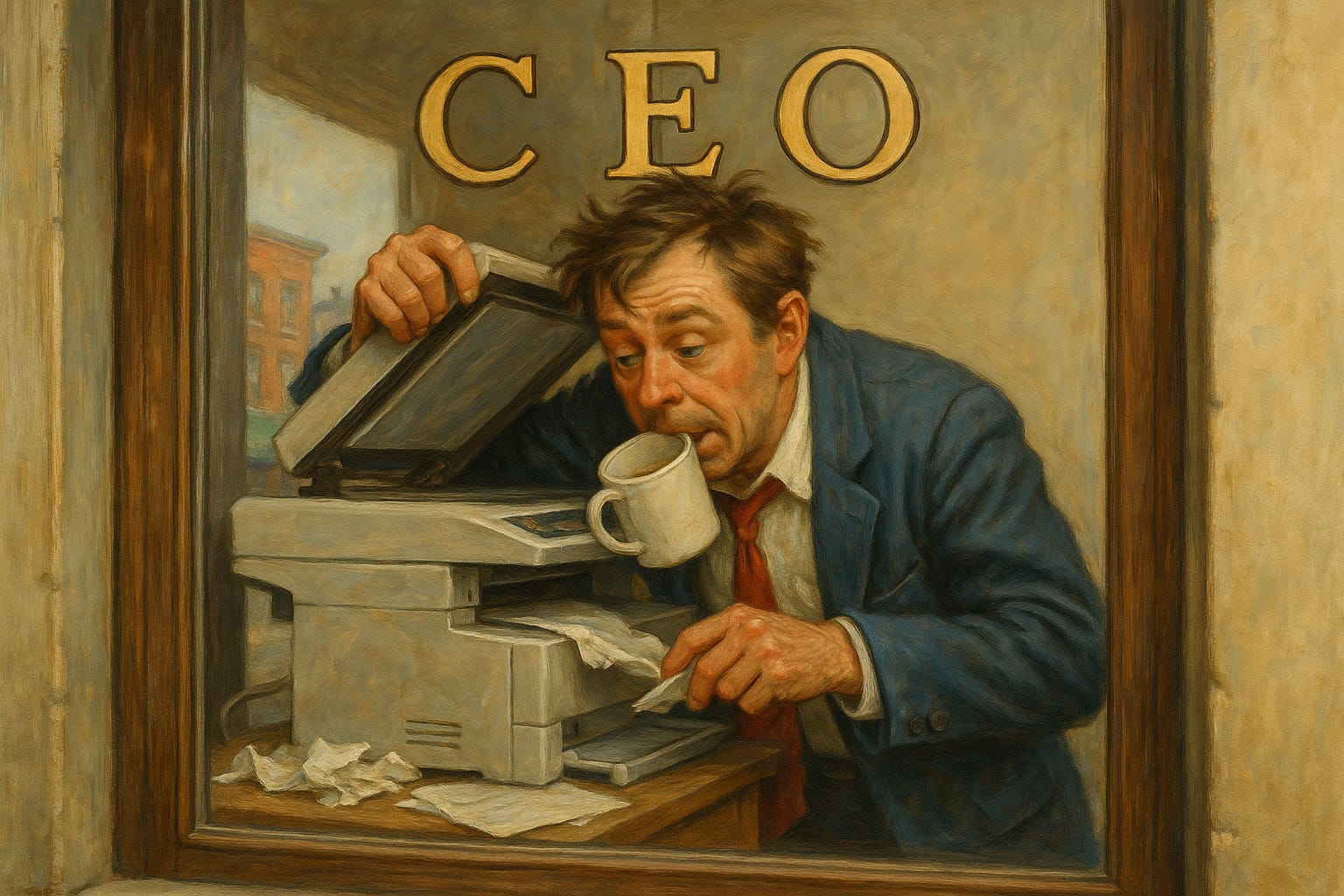
I read Erin Green’s post in the quiet of the morning — the kind of scroll that stops you mid-swipe.
It was about the psychology of buying — how almost every decision happens before logic even joins the conversation.
“Professionals make safety feel effortless.”
That line stayed with me. Because a few days earlier, I’d sat through a sales call that embodied the opposite — not maliciously, just structurally. A small, ordinary collapse of detail that made everything feel unsafe before a word had been sold.
The Setup
It started with a message from a director of sales. He had the kind of pedigree that usually signals competence — big blue-chip tech background, years of experience in enterprise sales. The note was simple: business development opportunity.
The site he linked to didn’t help. It looked like every template-built service company trying to be everything at once: “LinkedIn experts,” “growth partners,” “revenue generators.” A dozen phrases that said nothing. But curiosity is part of the job. I take first meetings because, every so often, something real hides behind bad design.
He followed up quickly, saying the founder would also join the call. Also was the keyword. I expected two people — the operator and the owner.
Then the calendar invite arrived. The agenda sat neatly in the notes, the kind of boilerplate that already tells you what the experience will be:
Your business, including its products, services, and goals…
What we do to win clients new business.
Pricing.
Next steps.
And at the top, a line that made me smile for the wrong reason:
When you book a call, you’ll automatically be penciled in with your LinkedIn expert.
Except I hadn’t booked them.
They’d booked us.
I turned to my partner and said, “Watch this. This is going to be a cold-call demo in disguise. He’ll want me to explain what we do so he can pitch it back to me. He’ll call it ‘personalization,’ but it’s really just guessing on camera.”
My partner laughed. We both knew the type.
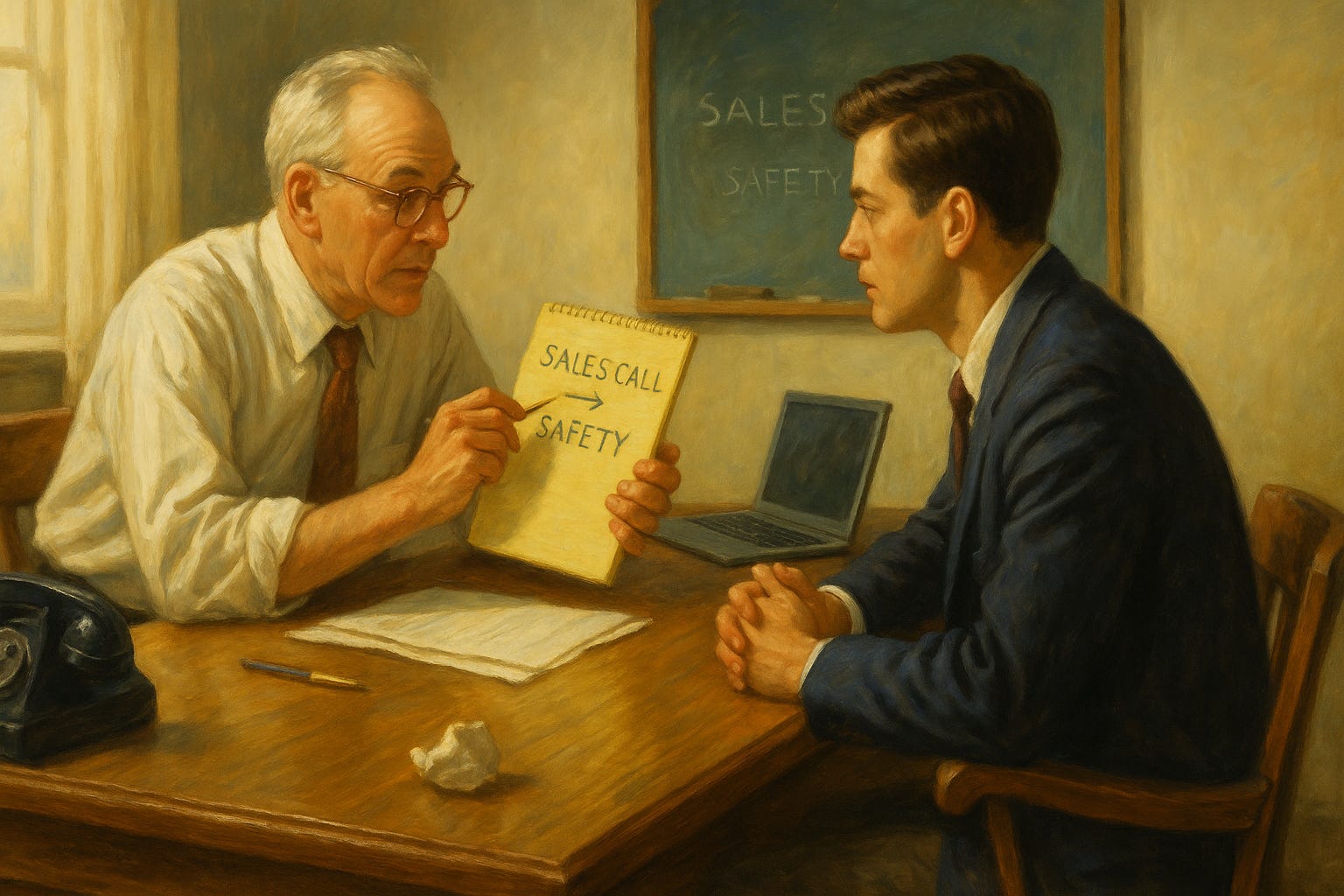
The Call
Only one square lit up when the meeting started — the founder. No director of sales. No apology. No mention. The camera was tilted too high, the energy already off.
He opened with the line I’d predicted to the syllable: “So tell me a little about what you do.”

I smiled, quietly, inwardly. The small grin of confirmation when a hypothesis lands. I caught my partner’s eyes on the other screen — the silent told you so that only two people can share mid-meeting.
I let him run for a bit. Then I stopped him.
“You reached out to us,” I said. “Why don’t you start?”
He stumbled, rewound, restarted. The sentences came out like cards dealt from an old deck — the same pitch he’d probably used a hundred times. No evidence of research, no curiosity, just the cadence of a man following a script he no longer believes in.
That’s when my role shifted. He thought he was selling me; I decided to use him as a live lesson. My partner is younger, and sometimes the best way to teach what not to do is to let someone else demonstrate it perfectly. So I stayed on the call. Every minute of it.
He wasted my time, but he didn’t waste my partner’s. Because now he knows exactly what bad looks like — what unprepared feels like, what fear smells like, how quickly confidence drains out of a room when someone arrives with nothing but a pitch deck and hope.
The Aftermath
The follow-up email landed within the hour. A “proposal,” if you could call it that — a single page with logos splashed like stickers, each one demanding attention, none earning it. A layout that shouted look at me instead of trust me.
That was the moment the pattern clicked. This wasn’t a one-off bad call. It was a system failure disguised as hustle.
Because here’s the truth — there’s nothing wrong with a founder joining a sales call. But if you’ve hired a director of sales, and you’re still taking every call yourself, you don’t have a sales process. You have a bottleneck. You’ve built roles you don’t trust to do their job. That’s not leadership. That’s fear.
And fear is the enemy of safety.
I wrote back. Politely. A clean no, thank you. I could have ghosted. I didn’t. He asked for feedback.
So I gave him a gift — founder to founder, line by line. Where it went wrong, why it felt unsafe, and what preparation would have looked like if he wanted another outcome.
He didn’t take it well. Defensiveness is the instinct of the unready. But that’s fine. I wasn’t writing for him. I was writing for everyone still learning how to carry care forward — for the people who will one day be in his seat and need to know what safety actually feels like.

The Lesson
Erin’s post came a few days later. Her line echoed the whole thing back to me:
“Professionals make safety feel effortless.”
That’s the word — feel. Because safety isn’t a bullet point on a slide. It’s a felt sense that someone has already done the thinking, that they’ve built a structure around you so you don’t have to brace.
It’s in the first thirty seconds of a meeting, when the agenda proves they know who they’re talking to.
It’s in the design of the follow-up, where the typography and tone align with what they said on the call.
It’s in the discipline of showing up prepared enough that the other person can relax.
Safety is proof of care, made visible through detail. And when it’s absent, fear leaks through every pixel.

This founder wasn’t a villain. He was just unprotected by his own system — trying to improvise competence instead of codifying it.
That’s how businesses quietly corrode from the inside: presence replacing preparation, hierarchy standing in for trust.
The irony is that I didn’t leave the call angry. I left amused. Grateful, even. Because it reminded me how fragile professionalism becomes when it’s built on personality instead of process.

Nothing Lost
That call didn’t cost me anything but forty minutes. It bought my partner a lesson worth years.
He saw what happens when someone reaches out promising expertise but delivers uncertainty.
He saw that a company claiming personalization without a single personal gesture has already told you everything you need to know.
He saw that fear is loud — but safety is quiet.
The man on that call was selling shortcuts.
What he gave me instead was proof that the long way still wins.
Professionals make safety feel effortless.
Not because it is —
but because they’ve built a system strong enough to carry the effort for everyone else.
The details aren’t decoration. They’re everything.