

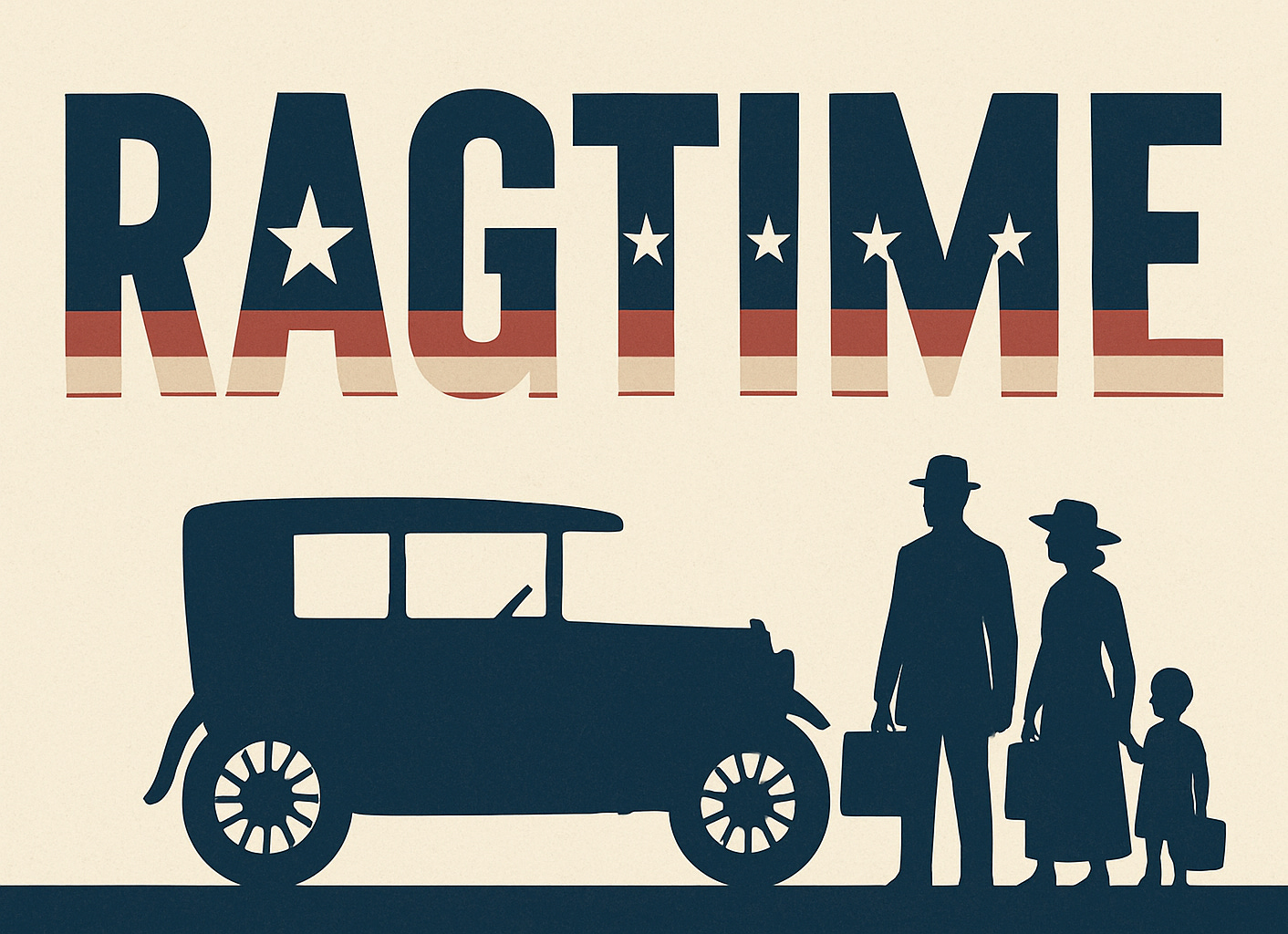
I wasn’t looking for anything profound—I was doom-scrolling Reddit, the stand-up clips were on autoplay. A comic was doing crowd work: “what do you do?” “we’re in theatre.” “what are you producing?” “Ragtime.” That one word hit a tuning fork I didn’t know was still sitting on the shelf.
I flashed back to the first time Ragtime cracked my own world open: a touring production in South Florida. West Palm Beach, velvet seats, the first musical that didn’t feel winky or campy to me. It was tragic and braided—three Americas on the same stage, singing past and into each other. I didn’t know E. L. Doctorow yet, just that someone had put a feeling I had about this country into a story that moved. (Doctorow’s novel really did change the weather for historical fiction when it arrived in 1975.)


If you’ve ever tried to describe Ragtime to someone who hasn’t seen it, you end up either underselling it (“a big period musical!”) or over-intellectualizing it. It is a score that lifts you up by the lapels (Flaherty & Ahrens), a book that refuses to blink (McNally), and staging that—at least in 1998—went for broke. The original Broadway production opened at the brand-new Ford Center for the Performing Arts on January 18, 1998, and ran 834 performances. It was also, infamously, very expensive—roughly $10–$11 million at the time—and came with onstage fireworks and a working Model T. Depending on your taste that was spectacle, poetry, or both.
The show led the Tonys with 13 nominations and won four—Score, Book, Orchestrations, and Audra McDonald’s devastating Featured Actress turn as Sarah—while The Lion King took Best Musical.
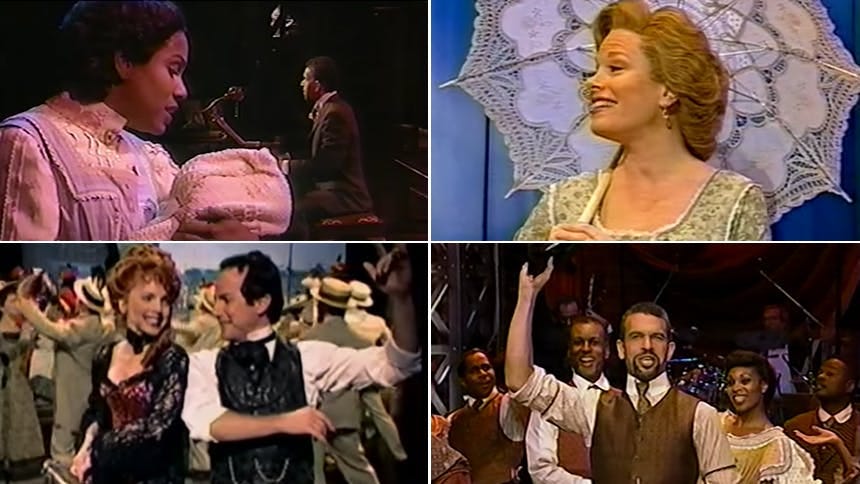
If you found Ragtime the way I did, you might have come in through PBS. There was a Great Performances documentary, Creating Ragtime, that aired in January 1998, with Whoopi Goldberg hosting and the creative team and Doctorow front and center. It isn’t a pro-shot of the full show (I wish); it’s an hour that captures the electricity of building something that big from the ground up.
“Maybe even extravagant, sure—but it carried conviction. And more than that, it carried optimism: that even through heartbreak, the future of America is still possible, as long as we actually want it.”
There was a revival in 2009 that transferred from the Kennedy Center to the Neil Simon. Critics praised it, but the run ended after just 65 performances. Commercially unlucky, artistically admired—the paradox that keeps following this show.
And now: the tuning fork again. After last season’s sold-out City Center gala, Ragtime is officially set to return this fall at Lincoln Center Theater—the Vivian Beaumont—headlined by Joshua Henry, Caissie Levy, and Brandon Uranowitz for a 14-week limited run.


Why bother, in 2025, with a musical that looks backward? Because Ragtime doesn’t really. It looks at the present through the back door. The immigrant’s camera, the White family’s carefully ordered home, Coalhouse’s car—every object is a motive. We like to tell ourselves that the America of the early 1900s is gone; that the heat we’re feeling now is novel. Ragtime doesn’t agree. It insists that the collisions—race, class, capital, celebrity, gender, labor, the machinery of progress—are not an era but a loop. (“Make them hear you,” indeed.) Some critics found the original staging overwrought. I thought it was magnificent. Maybe even extravagant, sure—but it carried conviction. And more than that, it carried optimism: that even through heartbreak, the future of America is still possible, as long as we actually want it.
When I think “great American musical of the modern era,” I put it in the small circle with Porgy and Bess—works that refuse to flatter the version of America we put on brochures. Doctorow’s novel was ahead of its time in the way it jams historical celebrities into the mundane lives of ordinary people and asks what’s performance and what’s power. The musical doubles down: it lets the orchestra argue with the libretto, the choreography argue with the set, and the people on stage argue with the times that made them. That friction is the point.
So yes, I want to see Ragtime again—this time with more mileage on me and less tolerance for sentimental shortcuts. I don’t need the fireworks or the car (though the car is dramaturgically perfect); I want the argument. I want to sit in a room with strangers and listen to the country talk to itself in harmony and dissonance. I want to be reminded that “back to before” is a fantasy lyric, not a policy. And I want the arts moving, not because they make us feel good, but because they make us see straight.
If you’re going, I’ll see you at the Beaumont. If you’re not, the PBS documentary is still a fine way to remember what it felt like when this music first found you.
If You Go
What: Ragtime (Second Broadway Revival)
Where: Lincoln Center Theater at the Vivian Beaumont
When: Fall 2025, 14-week limited run
Cast: Joshua Henry (Coalhouse Walker Jr.), Caissie Levy (Mother), Brandon Uranowitz (Tateh)
Tickets: Lincoln Center Theater